From: andy.cain <andy.cain@comcast.net>
Sent: Sunday, May 10, 2026 5:46 PM
To: Mike Brattland <mgbrattland@gerlecreek.com>
Subject: Fwd: “Rape is just part of war”: what happened when I spoke in Amsterdam
Sent from my Galaxy
-------- Original message --------
From: Albie Fox
---------- Forwarded message ---------
From: Andrew Fox from Fox On War <mrandrewfox@substack.com>
Date: Sat, 9 May 2026 at 16:13
Subject: “Rape is just part of war”: what happened when I spoke in Amsterdam
To:

What I witnessed at a Dutch university revealed how propaganda, intimidation, and moral inversion have consumed parts of the Western pro-Palestinian movement.
͏ ͏ ͏ ͏ ͏ ͏ ͏ ͏ ͏ ͏ ͏ ͏ ͏ ͏ ͏ ͏ ͏ ͏ ͏ ͏ ͏ ͏ ͏ ͏ ͏ ͏ ͏ ͏ ͏ ͏ ͏ ͏ ͏ ͏ ͏ ͏ ͏ ͏ ͏ ͏ ͏ ͏ ͏ ͏ ͏ ͏ ͏ ͏ ͏ ͏ ͏ ͏ ͏ ͏ ͏ ͏ ͏ ͏ ͏ ͏ ͏ ͏ ͏ ͏ ͏ ͏ ͏ ͏ ͏ ͏ ͏ ͏ ͏ ͏ ͏ ͏ ͏ ͏ ͏ ͏ ͏ ͏ ͏ ͏ ͏ ͏ ͏ ͏ ͏ ͏ ͏ ͏ ͏ ͏ ͏ ͏ ͏ ͏ ͏ ͏ ͏ ͏ ͏ ͏ ͏ ͏ ͏ ͏ ͏ ͏ ͏ ͏ ͏ ͏ ͏ ͏ ͏ ͏ ͏ ͏ ͏ ͏ ͏ ͏ ͏ ͏ ͏ ͏ ͏ ͏ ͏ ͏ ͏ ͏ ͏ ͏ ͏ ͏ ͏ ͏ ͏ ͏ ͏ ͏ ͏ ͏ ͏ ͏ ͏ ͏ ͏ ͏ ͏ ͏ ͏ ͏ ͏ ͏ ͏ ͏ ͏ ͏ ͏ ͏ ͏ ͏ ͏ ͏ ͏ ͏ ͏ ͏ ͏ ͏ ͏ ͏ ͏ ͏ ͏ ͏ ͏ ͏ ͏ ͏ ͏ ͏ ͏ ͏ ͏ ͏ ͏ ͏ ͏ ͏ ͏ ͏ ͏ ͏ ͏ ͏
You’re a paid subscriber — thank you. Today’s post is free for everyone (so you can share it widely), but your subscription is what funds the work that makes Fox On War different. “Rape is just part of war”: what happened when I spoke in AmsterdamWhat I witnessed at a Dutch university revealed how propaganda, intimidation, and moral inversion have consumed parts of the Western pro-Palestinian movement.
Today is going to be a bit of a different article. I want to tell you what happened to me this week in the Netherlands. I was invited to speak at a conference organised by Thinc, a Dutch think tank, on the weaponisation of international law against Israel. My first talk to the main audience was about the psychological function of that weaponisation. The point I made was simple: accusations against Israel are no longer treated as accusations; they are presented as verdicts. The allegation becomes the punishment. Israel is accused of genocide, apartheid, ethnic cleansing, collective punishment, starvation, war crimes, and so on. In normal legal reasoning, such claims are tested against evidence, definitions, context, intent, precedent, and the conduct of the enemy. However, in anti-Israel discourse, the accusation itself is treated as a judgment. The charge is enough. The slogan is enough. The process becomes the stick with which the Jewish state is beaten. My second speech was at the Free University in Amsterdam alongside the superb Anne Herzberg and Danny Orbach. I am told the event had been difficult to organise. The university had hosted pro-Palestinian events, but this was apparently the first event that could be considered to have given a more balanced perspective, and the organisers had to jump through a number of hoops to make it happen. When we arrived, security escorted us to the lecture room. This was something of a clue that things were not normal. Outside the room, we were met by what I suppose you could call an arrivals committee: four activists in keffiyehs, silently holding Palestinian flags. That gave us a fairly good sense of how the morning would go. Once we entered the room, they followed us in and sat together at the back, still wearing their keffiyehs and carrying their flags. There was no attempt to engage. No appearance of curiosity. No indication that they had come to listen. They had come to perform.
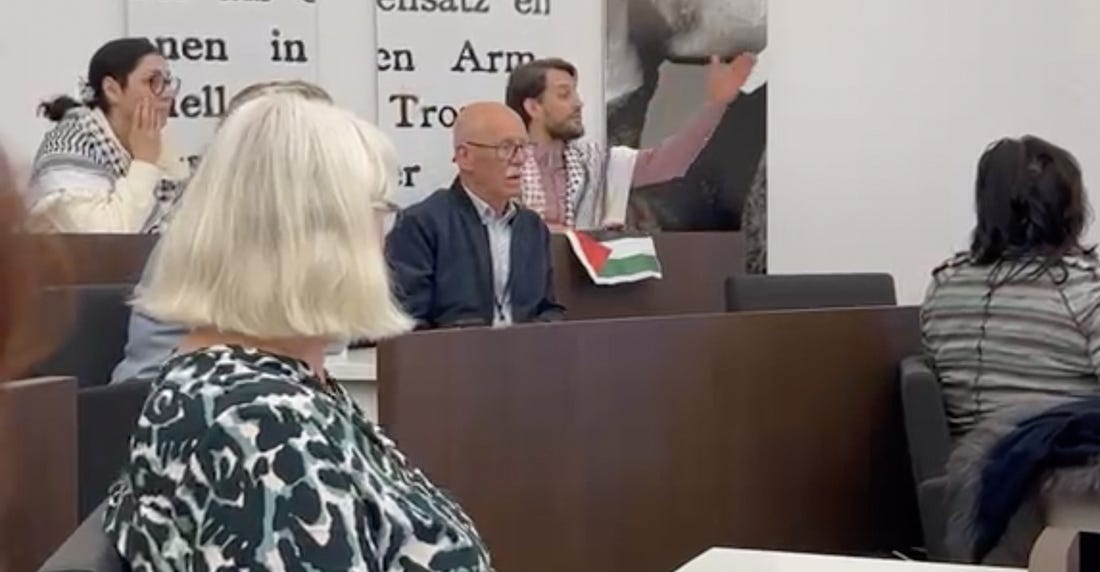
A still from a video of the interruption My talk began with the basic strategic point that viewing Gaza in isolation is a mistake. 7 October did not merely start a war between Israel and Hamas in Gaza. It sparked a regional war. Israel has been fighting across seven fronts: Hamas in Gaza, Hezbollah in Lebanon, the Houthis, Iranian-backed militias in Iraq and Syria, the West Bank, and Iran itself. (That is the subject of my forthcoming book. I go through the history of each of those proxies, how they came to be integrated into Iran’s regional strategy, and how Israel has dealt with each one since 7 October 2023.) From there, I turned specifically to Gaza. Israel’s reason for going to war in Gaza was the 7 October massacre. That fact has been almost entirely erased from the discussion. The war is now spoken of as though Israel simply woke up one morning and decided to destroy Gaza for no reason. Hamas has managed, with extraordinary success, to erase itself from the conversation. I spoke about the massacres of 7 October. I spoke about the sexual violence. I spoke about what Hamas did to Israeli civilians. This, I believe, is the only correct framing for why Israel chose the strategy and thus the tactics it did in Gaza. Then I made the point that is so often missing from the conversation: Israel was fighting Hamas in Gaza, not “the Gazan people” as an undifferentiated whole. The distinction goes to the heart of the genocide allegation. Genocide requires dolus specialis: the specific intent to destroy, in whole or in part, a protected group as such. That is a very high legal threshold. It is not enough to point to devastation. It is not enough to point to civilian casualties, however terrible. One must establish intent. Israel has killed large numbers of Hamas fighters. The figure commonly cited by the IDF is around 25,000. As I showed in my December 2024 paper, Israeli figures on combatant deaths have historically been broadly credible, just as the death tolls produced by the Hamas-run Ministry of Health in Gaza have often been treated as broadly usable, even though they lack the crucial distinction between civilians and combatants. The point is that both can be true at once: Gaza has been devastated, and Israel has been fighting an embedded military enemy. Israel has also paid a significant military price. More than 900 Israeli soldiers have been killed in action, and thousands have been severely wounded. That does not happen when a state simply massacres a passive civilian population from the air. It happens when soldiers are engaged in sustained ground combat against an armed enemy operating in tunnels, civilian infrastructure, booby-trapped buildings, and dense urban terrain. I also spoke about the IED threat. Israeli forces have encountered explosive devices across Gaza at an extraordinary density. In some areas, multiple IDF soldiers have described the threat to me as appearing at least every hundred metres or so in some areas of Gaza. That is part of why the destruction looks the way it does. Much of it is not simply the result of airstrikes; the majority of damage is the result of ground manoeuvres in a heavily booby-trapped urban battlespace. When buildings are damaged, tunnelled through, rigged with explosives, or structurally unsafe, the Israelis have often bulldozed them. That tactic can be criticised and should be debated, but criticism of a tactic is not the same as proving genocide. Then came the questions. The first to stand was a man in a white T-shirt who appeared to be affiliated with the university. He moved towards me in a confrontational manner. White spittle gathered at the corner of his mouth as he began hectoring me. His argument, if it can be called that, was that the rape on October 7 was merely a feature of the longer, broader conflict between Israel and Palestine since 1948, he alleged, on both sides. He then accused Israelis of rape and said that I was only talking about the sexual violence committed by Hamas because I wanted to dehumanise Palestinians. I will admit it: I became annoyed. I have seen the evidence of sexual assault from 7 October firsthand. My first draft of this article contained a description of some of the horrific evidence I have seen. I decided to leave it out to spare you all. The critical point is that the sexual violence on 7 October was no ordinary “feature” of war. It was an orgy of sadism. It went far beyond anything that had occurred in this conflict before. So I responded by describing what I had seen. I made the point that I was not dehumanising Hamas. Hamas dehumanised itself on 7 October, and when Yoav Gallant described Hamas as fighting human animals, he was absolutely correct. The room then descended into a shouting match. One of the activists at the back was warned by security that he would be removed if he continued. He immediately tried to recast the warning as a threat of violence against him. The performance was instant: provocation first, victimhood second. To his credit, the moderator did an excellent job of calming the room. Without him, the situation could easily have deteriorated further. Unfortunately, there was also a journalist from a newspaper hostile to our position in the room (he was not invited by the organisers, so draw your own conclusions about how he came to be there, and why). The article that followed was predictable. We were blamed. The activists were cast as victims. The same pattern repeated itself: disrupt, provoke, invert, accuse. For me, the morning was a lesson. I am primarily a writer, but I have also given speeches. I am a qualified university lecturer and a Fellow of the Higher Education Authority. However, I have never previously experienced an incident in which pro-Palestinian activists turn up determined to create a scene. What struck me most was not just the hostility: it was the epistemic closure. These people operate within a sealed universe of alternative facts. There is no argument to be had because there is no shared evidentiary standard. I know what I have seen with my own eyes in Gaza itself during the war. They, on the other hand, have absorbed two and a half years of propaganda via social media, activist networks, campus politics, and the Hamas narrative laundered through supposedly respectable institutions. Those two evidentiary bars are not the same. That is the truly dangerous part. When two sides disagree about policy, there can still be debate. When two sides disagree about interpretation, there can still be debate. However, when one side insists on living in a manufactured reality, conversation becomes almost impossible. That is what I saw in Amsterdam; neither serious engagement nor moral seriousness. Not even real anger, in the sense of an emotion tied to facts. What I saw was a political identity built from keffiyehs, flags, slogans, and inverted victimhood. It was a glimpse into how toxic this movement has become. Not because it advocates for Palestinians (there is nothing inherently wrong with advocating for Palestinians), but because so much of the Western pro-Palestinian movement has now fused with denial, propaganda, theatrical intimidation, and the moral laundering of Hamas. That is the world we are dealing with, and after what I saw in Amsterdam this week, I am more convinced than ever that the fight is not only about Israel, Gaza, or international law. It is about reality itself. For those who use such platforms, I am now on both Instagram and YouTube. Here are the links. Please feel free to subscribe! If you would like more video content, let me know in the replies, and I will do my best. This Substack is reader-supported. To receive new posts and support my work, consider becoming a free or paid subscriber. This post went to the whole list, but your subscription is the reason it exists. Paid readers cover the cost of travel, fieldwork and the hours of research it takes to turn that into something more useful than a hot take. Thank you. If you know one person who’d value this kind of reporting, feel free to forward it — you’re the reason this community grows. If you’d like to back this work for the long haul, you can switch to an annual plan in one click in your account settings. If there’s anything I can do to make this subscription more valuable to you, just let me know by reply.
© 2026 Andrew Fox
|




--
Albie Fox
07876443221