From: Harold Brattland <habrattland@arvig.net>
Sent: Monday, June 15, 2026 1:34 PM
To: Brattland, Mike * <mgbrattland@gerlecreek.com>
Subject: Aviation Week :: The Week In Technology, June 8-12, 2026
Check out this site https://aviationweek.com/aerospace/emerging-technologies/week-technology-june-8-12-2026
--
The Week In Technology, June 8-12, 2026
Graham Warwick June 08, 2026

GE Aerospace completed ground testing of a megawatt-class hybrid-electric engine.
Credit: GE Aerospace
GE Tests Hybrid-Electric Propulsion System
GE Aerospace is preparing to flight-test a megawatt-class hybrid-electric engine on a modified Saab 340B testbed following completion of ground tests of the propulsion system at its Peebles, Ohio, facility.
Developed under NASA’s Electrified Powertrain Flight Demonstration (EPFD) project, the system is based on a GE CT7 turboprop fitted with GE-developed motor/generators, power converters, inverters and controllers. The engine is also configured with a Dowty propeller, Avio Aero gearbox and BAE Systems batteries. Boeing subsidiary Aurora Flight Sciences is supplying the nacelle.
Completion of ground tests marks a milestone for GE’s EPFD effort, which began in September 2021 with the award of a $179 million NASA contract. Further progress came in 2022 when the propulsion system operated in simulated altitude at the NASA Electric Aircraft Testbed (NEAT) in Sandusky, Ohio.
Tests at Peebles simulated operational phases, ranging from taxi and takeoff to climb and cruise. “The electric powertrain helped successfully power the propeller and generated power to the battery,” GE says, adding: “Flightworthy components that meet higher safety and reliability requirements than typical test hardware were used as part of GE Aerospace’s efforts to mature a commercial-grade hybrid-electric engine system.”
“The ground test is a major turning point in our understanding of hybrid-electric powertrains for aviation and a fundamental building block for the future,” says Arjan Hegeman, vice president for future of flight at GE.
GE also recently tested a modified Passport business jet engine in hybrid-electric mode, marking a key step toward development of a future single-aisle propulsion system under CFM International’s Revolutionary Innovation for Sustainable Engines (RISE) initiative.
The tests marked the culmination of the Turbofan Engine Power Extraction (PEx) program under NASA’s Hybrid Thermally Efficient Core (HyTEC) initiative to develop compact, high-power-density cores for integration with larger, lower-pressure fans—thereby enabling higher bypass ratios for greater propulsive efficiency.
Lessons learned from HyTEC and PEx are informing the RISE initiative, GE’s program with CFM partner Safran aimed at development of a new centerline engine with 20% better fuel efficiency than today’s CFM Leap-1.
—Guy Norris, Colorado Springs
Study: Ambition in Decarbonization Would Pay Off
An ambitious strategy to decarbonize aviation by 2070 would require billions of dollars in annual investment but would avoid trillions of dollars in long-term societal costs from aviation’s climate impact, a Bauhaus Luftfahrt study concludes.
“Despite high investment costs, greater ambition for climate-friendly aviation will pay off economically,” says Mirko Hornung, executive director of research and technology at the Munich-based aviation think tank, which is backed by Airbus and other aerospace entities.
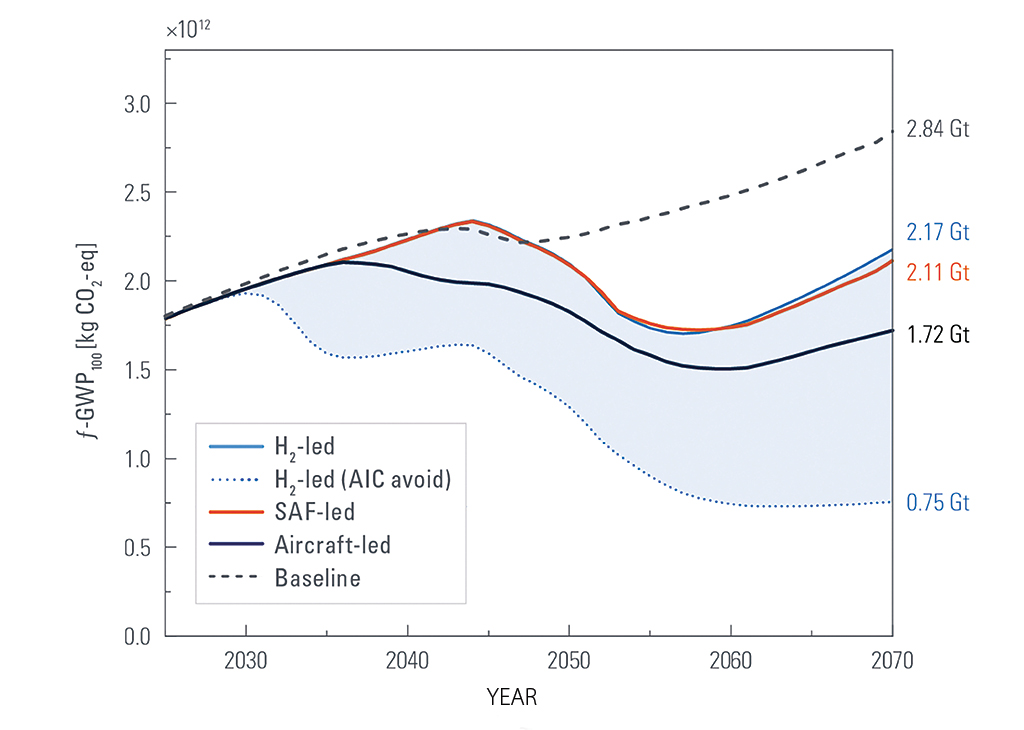 A Bauhaus Luftfahrt study assessed the societal costs of aviation’s climate impact across various decarbonization pathways. Credit: Bauhaus Luftfahrt
“An ambitious transformation will pay off for the overall economy as early as 2050, when highly efficient aircraft using sustainable fuels significantly reduce the societal costs of climate change,” he says.
The study looked at four potential futures—a conservative baseline assuming 70% sustainable aviation fuel (SAF) use by 2070 and three more aggressive scenarios: 100% SAF use by 2060, 60% more efficient aircraft combined with SAF, and a “radical switch” to liquid hydrogen.
In all scenarios, the use of higher-priced alternative fuels, SAF or hydrogen would increase direct operating costs per passenger-kilometer 35-55% by 2070. Even achieving a baseline of 70% SAF use by 2070 would require several hundred billion dollars in annual investment, and 100% SAF use by 2060 would increase the cost by 30%, the study says.
The conservative 70% SAF pathway would initially be about 10% cheaper per passenger-kilometer than the other scenarios, Bauhaus says, but the gap would gradually narrow, reverse after 2050 and then exceed the projected costs for all the more ambitious pathways.
“Although hydrogen-powered aircraft incur higher acquisition costs, they can lead to lower operating costs in the longer term, primarily due to increasing synergies within the energy system,” the think tank says.
“Highly efficient next-generation aircraft offer the greatest potential for significantly mitigating fuel-related cost increases—despite high development and acquisition costs,” Bauhaus Luftfahrt says.
Under the study’s baseline 70% SAF scenario, annual emissions would reach about 2.84 gigatons of CO2 equivalent by 2070, an increase of around 60% over 2025. Increasing SAF use to 100% by 2060 would reduce 2070 emissions by 24%, the study says.
Emissions would decrease by 40% under the highly efficient aircraft plus SAF pathway and by up to 74% in the best-case scenario combining the radical-hydrogen pathway with minimizing non-CO2 emissions by avoiding aviation-induced contrails.
Even after accounting for the billions of dollars in annual investment required for alternative fuels production and highly efficient aircraft development, Bauhaus projects trillions of dollars in avoided societal costs across health, agriculture, energy systems and weather patterns.
By 2070, the cumulative additional societal costs of aviation’s climate impact could reach $43.7 trillion under the conservative baseline scenario, Bauhaus projects. The 100% SAF pathway could reduce this cost by 10% and the highly efficient aircraft route by 23%.
NASA Previews Advanced Airliner Ideas
NASA has teased results from 18-month studies by industry and academia to identify technologies and concepts for ultraefficient commercial aircraft that could enter service around the middle of the century.
The five studies were conducted under NASA’s Advanced Aircraft Concepts for Environmental Sustainability (AACES) 2050 project, launched in 2024. AACES is modeled on N+3 studies completed in 2010 that shaped NASA’s research into hybrid wing body and truss-braced wing aircraft concepts and hybrid-electric propulsion.
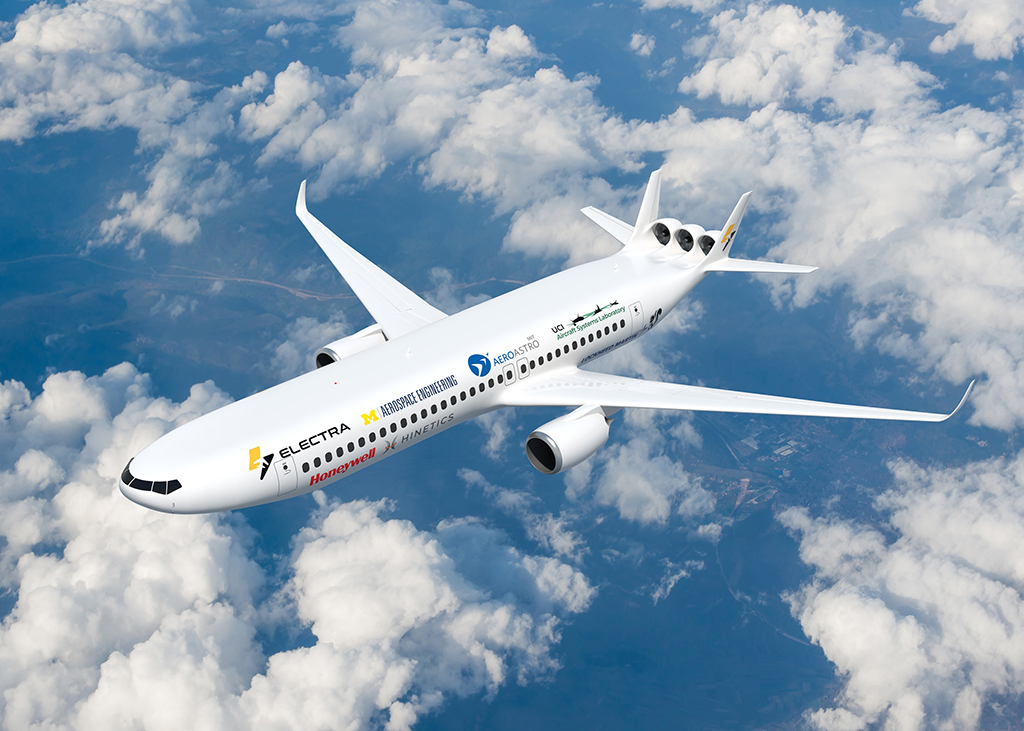 Electra’s concept combines a lifting fuselage with drag-reducing boundary-layer ingestion. Credit: Electra.aero
The AACES Phase 1 contracts to develop future scenarios and identify technologies and concepts were awarded in November 2024 to Boeing company Aurora Flight Sciences, Electra.aero, Georgia Institute of Technology, JetZero and Pratt & Whitney.
In an April briefing to industry on its planned Aeronautics Flight Accelerator (AFA) project to conduct near-term flight experiments, NASA indicated it expected the AACES studies to lead to integrated system demonstrations of radical airframe and propulsion combinations, “paradigm-busting” configurations and technologies for multiple fuel options.
NASA, previewing the teams’ planned presentations at the American Institute of Aeronautics and Astronautics’ Aviation 2026 conference in San Diego on June 8-12, posted images of advanced aircraft concepts.
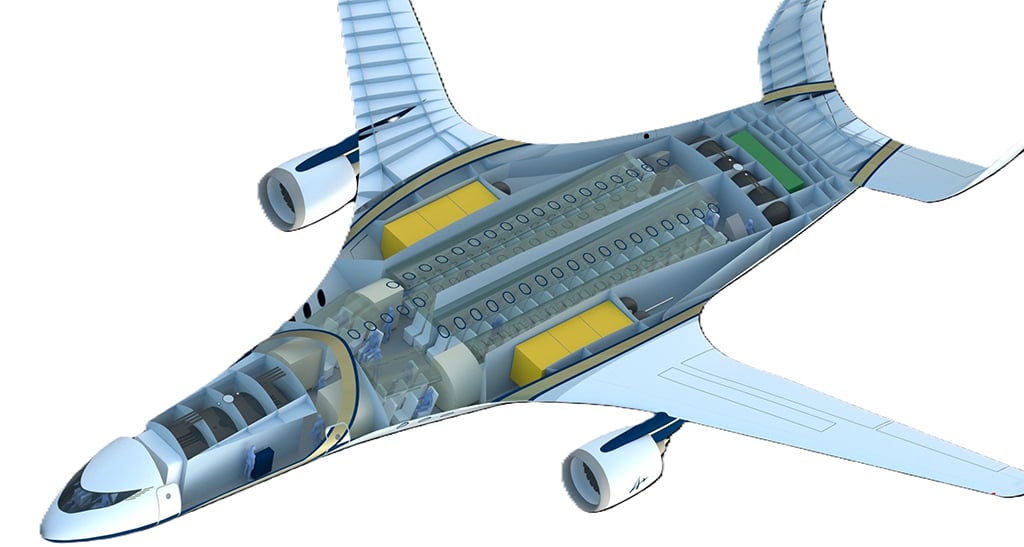 Georgia Tech’s concept features a twin-aisle blended wing centerbody with hydrogen tanks in the nose and tail. Credit: Georgia Institute of Technology
Aurora has yet to reveal any of its designs, but NASA posted an image of an Electra concept combining a twin-aisle “double-bubble” lifting fuselage with fans embedded in the tail to reduce drag by ingesting and reenergizing the upper-fuselage boundary layer.
The design is similar to the concept released by hybrid-electric startup Electra when it won the AACES contract in 2024 but has conventional underwing engines where the original design had an array of wing leading-edge propellers providing blown lift.
Georgia Tech’s ATH2ENA concept combines a conventional forward fuselage with a twin-aisle blended-wing centerbody and wide, flat aft fuselage and U-tail as well as conventional underwing engines. The concept has hydrogen tanks in the nose and tail, cargo bays in the wing body blend areas and skylight windows for the passenger cabin.
Under ACCES, blended wing body airliner (BWB) developer JetZero explored technologies to enable cryogenic liquid hydrogen to be used as a fuel for commercial aviation, evaluating both tube-and-wing concepts alongside its own Z4 BWB design. Pratt & Whitney studied alternative propulsion concepts and integration schemes.
Electra was teamed with Honeywell, electric motor developer Hinetics, University of Michigan, Massachusetts Institute of Technology and University of California at Irvine for the ACCES Phase 1 study. JetZero was teamed with hydrogen-electric propulsion developer ZeroAvia and the University of Illinois Urbana-Champaign.
U.S. Special Operations Explores Channel-Wing VTOL
The innovation arm of U.S. Special Operations Command, SOFWerx, plans to assess the capabilities of uncrewed aircraft with hybrid-electric propulsion and channel wings for vertical takeoff and landing.
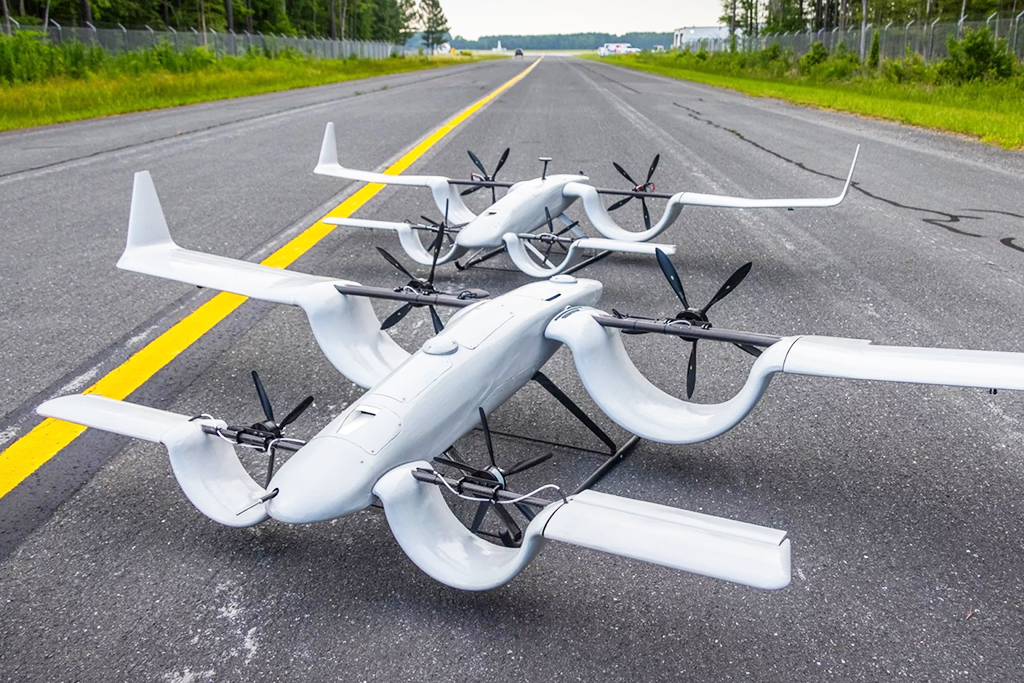 HopFlyt has flown prototypes of its channel-wing VTOL uncrewed aircraft. Credit: HopFlyt
SOFWerx on May 28 released a special notice seeking information on technologies for inclusion in the planned Channelized Wing Hybrid-Electric Vertical-Takeoff-and-Landing (Chevtol) uncrewed aircraft system (UAS) assessment event.
Planned for June 24-25, the virtual assessment event could lead to a contract award to demonstrate the technology readiness, operational characteristics and performance attributes of a channel-wing VTOL UAS.
The notice says Special Operations Command (SOCOM) is seeking a runway-independent hybrid-electric UAS for intelligence, surveillance, target acquisition and reconnaissance missions for which a prototype has already flown.
Invented in the 1940s by Willard Custer, the channel wing was an unconventional short-takeoff-and-landing (STOL) design that has reemerged as an eVTOL concept. Maryland-based startup HopFlyt has flown two 10-ft.-span electric-powered channel-wing VTOL UAS prototypes and is developing a 20-ft.-span version.
The Custer Channel Wing incorporates a U-shape section with a propeller toward the trailing edge of the channel. The propeller accelerates airflow through the channel, generating increased lift at low airspeed. In flight tests, Custer’s aircraft demonstrated significant STOL performance and potential for VTOL.
HopFlyt’s UAS has independently tilting wings and canards, each with a single channel. The surfaces tilt between vertical and forward flight; individually changing the tilt angle and thrust of each propulsion unit provides stability and control.
The startup is developing the Cyclone, a hybrid-electric VTOL UAS targeted at maritime logistics missions and designed to fly 250 lb. of cargo on a 100-nm roundtrip. The aircraft can also carry a 50-lb. payload 850 nm or fly for up to 12 hr.
In a May 26 LinkedIn post, Chief Engineer Neil Winston teased the imminent launch of the Squall, a Group 2 (under-55-lb.) channel-wing VTOL UAS and “HopFlyt’s first hybrid drone platform and our first commercial product offering.”
Competitive submissions for the SOFWerx Chevtol assessment event close on June 12, and a downselect is scheduled for June 15-16. Following the assessment event, contracts could be awarded for a Phase 4 demonstration through one of several contracting mechanisms, ranging from prototyping to procurement.
Japan Advances Balloon-Launched Rocket
Japanese startup AstroX and the Japan Aerospace Exploration Agency plan to conduct a joint stratospheric flight demonstration of an attitude control system to stabilize and orient a rocket suspended from a high-altitude balloon.
AstroX plans to develop a space transportation service using the Rockoon system, in which the rocket is lifted into the stratosphere by balloon then released to launch its payload into low Earth orbit.
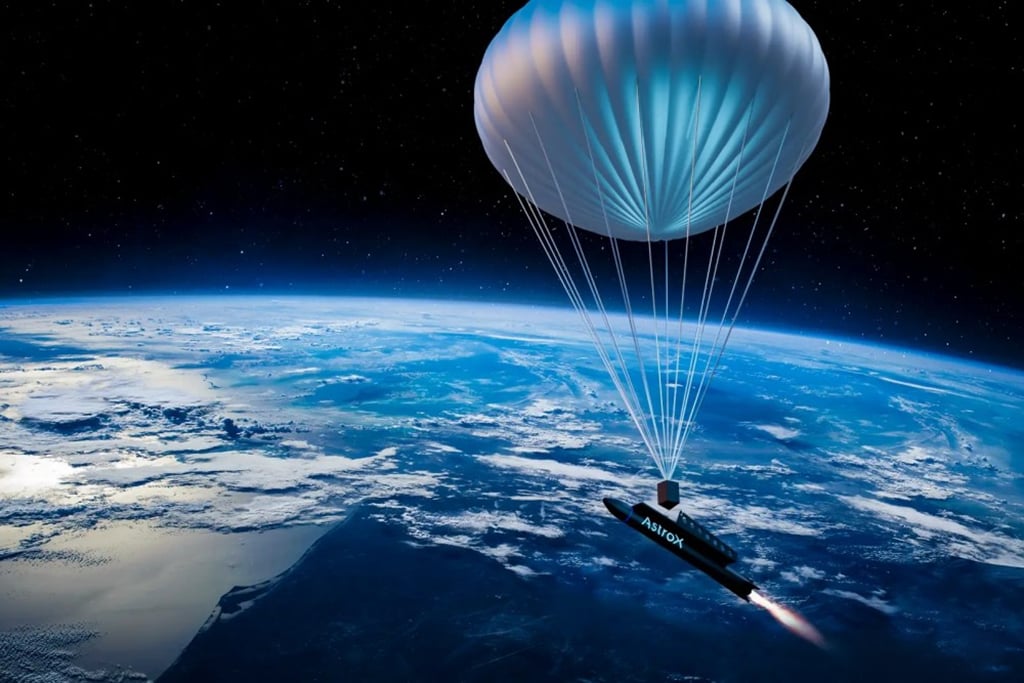 AstroX is developing the Rockoon stratospheric balloon-based space launch system. Credit: AstroX
The startup is developing an attitude control system package that can be used for Rockoon launches as well as other missions, including stabilizing stratospheric platforms and suspended systems, such as construction cranes.
To date, AstroX has conducted performance evaluations in a simulated stratospheric environment using a depressurized constant-temperature chamber, including tests involving wind disturbances. The startup has also performed suspension launch experiments with a small rocket.
After favorable results from these tests and ground-based environmental simulations and attitude-control system testing by the Japan Aerospace Exploration Agency, the partners plan to conduct system-level verification flights using stratospheric balloons already operated by the agency.