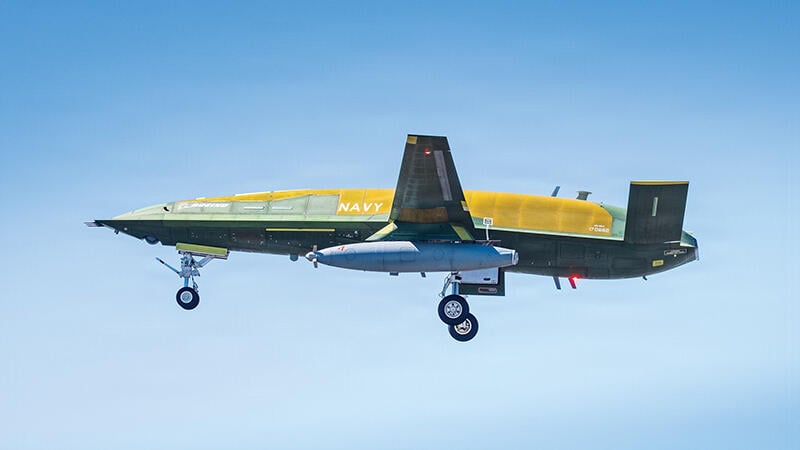
The production-representative version of Boeing’s carrier-based tanker aircraft completed a long-awaited first flight on April 25, marking a necessary step on the path to integrate its MQ-25 Stingray onto aircraft carriers and start topping off fuel tanks for the U.S. Navy’s aircraft fleet.
Behind the scenes, the company is working on a potential new version of the MQ-25 that would include a probe receiver to extend the Stingray’s 14-hr. endurance 71% to more than 24 hr. U.S. defense officials, meanwhile, are still trying to understand how many—and which—autonomous refueling platforms will fit into the Air Force’s long-sought Next-Generation Air Refueling System.
- Boeing is looking for new opportunities to extend the order pipeline
- The location of an added refueling probe is under study
Following the MQ-25’s 2-hr. flight from MidAmerica Airport in Illinois, Navy officials sounded pleased to see the baseline version of the Stingray enter flight testing after a 4.5-year delay.
“The successful first flight officially initiates the rigorous flight test program, which will focus on expanding the aircraft’s performance envelope and verifying all mission systems,” said Capt. Daniel Fucito, Unmanned Carrier Aviation program manager at Naval Air Systems Command.
When Boeing won the highly competitive MQ-25 contract in August 2018, Navy officials talked about putting the first production-representative model into flight testing as early as September 2021. That schedule seemed feasible when the T1, a Boeing-funded aircraft designed before the Navy finalized the requirements, flew in September 2019 and then refueled an airborne Northrop Grumman E-2D Advanced Hawkeye two years later.
But Boeing’s production system for the MQ-25 struggled early on. The company designed the aircraft to have nearly all of the parts put together using an automotive-industry-style full-size determinate assembly approach. In theory, that method accelerates production by pre-drilling holes for rivets to the assembly level. This avoids the time-consuming task of fixing small variances at the final assembly stage. But the manufacturer must account for the complexity of lining up the holes in subassemblies built by different suppliers.
Despite the long delay, Navy and Boeing officials still have big plans for the MQ-25, which comes with an average unit cost of about $181.6 million. All 76 Stingrays in the original program of record have survived.
Boeing also continues looking for new opportunities to extend the order pipeline. The company unveiled a concept in 2024 for a land-based version with 40% longer range, thanks to a wingspan extended more than 22% to 92 ft. The land-based version also featured a new refueling probe for the MQ-25, allowing the tanker to be refueled inflight by other MQ-25s or the Boeing KC-46.
The probe modification has evolved into the Autonomous Aerial Refueling Receive program, which is jointly funded by Boeing and the Navy. Receiving fuel inflight would increase the endurance of the MQ-25 to more than a full day, Alex Ewing, Boeing’s lead for the Advanced MQ-25 Integrated Product Team, told the Aerial Refueling Systems Advisory Group on April 22. If the Air Force and Navy could agree on a single jet fuel blend between the Air Force’s JP-8 and the Navy’s JP-5, the MQ-25 could receive fuel from the larger KC-46 and fly into contested airspace to top off fighters and bombers, he said.
“I think most people really understand that’s where you get much greater endurance, more than 24 hr.,” Ewing said. “And then if we get some fuel consolidation as well, [the MQ-25] opens itself up to possibly shuttle tanking as well.”
Boeing’s design team is still finalizing the location to install the probe on the MQ-25. A rendering released in 2024 depicts it positioned on the right side of the forward fuselage. But the designers seek to avoid interfering with the air data sensors. In a new rendering, the probe is positioned on top of the fuselage, but Boeing wants to avoid the area near the dorsal air inlet for the engine, Ewing said.
So far, testing has focused on the software that would control the MQ-25 probe to track the drogue basket of the refueling aircraft, whether it is an MQ-25, KC-46 or Lockheed Martin KC-130. Boeing has been using Learjet and Gulfstream testbed aircraft to simulate the conditions for the software to identify and track the drogue basket relative to the position of the refueling probe, Ewing said.