From: andy.cain <andy.cain@comcast.net>
Sent: Wednesday, April 8, 2026 5:07 AM
To: Mike Brattland <mgbrattland@gerlecreek.com>
Subject: Fwd: The end of the war, not the regime
One Briton's perspective.
Sent from my Galaxy
-------- Original message --------
---------- Forwarded message ---------
From: Andrew Fox from Fox On War <mrandrewfox@substack.com>
Date: Wed, 8 Apr 2026 at 09:29
Iran is battered but intact, America is spent, and the world is left to absorb the cost
͏ ͏ ͏ ͏ ͏ ͏ ͏ ͏ ͏ ͏ ͏ ͏ ͏ ͏ ͏ ͏ ͏ ͏ ͏ ͏ ͏ ͏ ͏ ͏ ͏ ͏ ͏ ͏ ͏ ͏ ͏ ͏ ͏ ͏ ͏ ͏ ͏ ͏ ͏ ͏ ͏ ͏ ͏ ͏ ͏ ͏ ͏ ͏ ͏ ͏ ͏ ͏ ͏ ͏ ͏ ͏ ͏ ͏ ͏ ͏ ͏ ͏ ͏ ͏ ͏ ͏ ͏ ͏ ͏ ͏ ͏ ͏ ͏ ͏ ͏ ͏ ͏ ͏ ͏ ͏ ͏ ͏ ͏ ͏ ͏ ͏ ͏ ͏ ͏ ͏ ͏ ͏ ͏ ͏ ͏ ͏ ͏ ͏ ͏ ͏ ͏ ͏ ͏ ͏ ͏ ͏ ͏ ͏ ͏ ͏ ͏ ͏ ͏ ͏ ͏ ͏ ͏ ͏ ͏ ͏ ͏ ͏ ͏ ͏ ͏ ͏ ͏ ͏ ͏ ͏ ͏ ͏ ͏ ͏ ͏ ͏ ͏ ͏ ͏ ͏ ͏ ͏ ͏ ͏ ͏ ͏ ͏ ͏ ͏ ͏ ͏ ͏ ͏ ͏ ͏ ͏ ͏ ͏ ͏ ͏ ͏ ͏ ͏ ͏ ͏ ͏ ͏ ͏ ͏ ͏ ͏ ͏ ͏ ͏ ͏ ͏ ͏ ͏ ͏ ͏ ͏ ͏ ͏ ͏ ͏ ͏ ͏ ͏ ͏ ͏ ͏ ͏ ͏ ͏ ͏ ͏ ͏ ͏ ͏ ͏
Forwarded this email? Subscribe here for more
Y
The end of the war, not the regime
Iran is battered but intact, America is spent, and the world is left to absorb the cost
Apr 8
This will be the last free post of my Iran war series. I hope you found them useful, and I would humbly suggest my last post was especially prescient! All I ask is that you like and share if you find them useful.
You can take advantage of the last day of my Easter Weekend sale and join thousands of other paid subscribers. 20% off a year’s subscription. Your support keeps the work going—thank you!
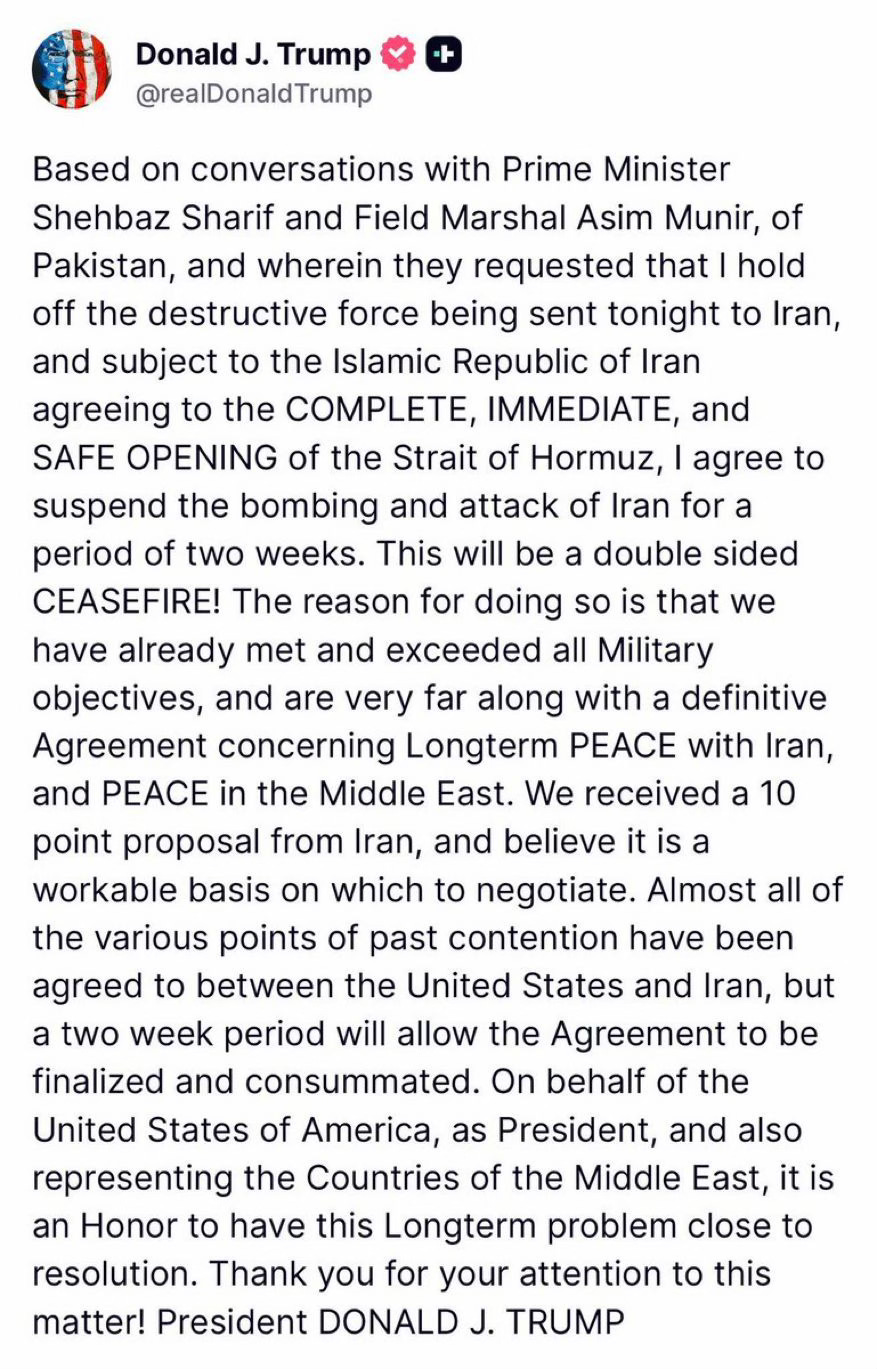
Last night’s announcement is unlikely to represent an enduring peace. It was a two-week ceasefire, agreed just before Trump’s own deadline to launch a much larger assault on Iran, with talks now scheduled to continue in Islamabad. Oil prices fell, markets rallied, and everyone exhaled. However, even in the early hours, the deal already appeared fragile, with reports of further missile exchanges and Israel making it clear that Lebanon was excluded. A ceasefire can end a phase of a war, but it cannot, on its own, resolve the political issues that caused it.
The timing alone suggests that Trump’s disgraceful, shameful weekend bluster about destroying civilisations was just political theatre. Negotiations of this magnitude do not emerge in the last ninety minutes before a deadline. Pakistan had already been calling for a pause; talks were ongoing before the deadline, and China was among the outside powers backing the diplomatic effort. The Strait of Hormuz had become an economic pressure point that Trump could not keep shut for much longer, so he needed an escape route and wanted it to look like a victory achieved through intimidation. That is why the threats became so exaggerated just before the ceasefire he knew was coming anyway.
On the military ledger, the United States and Israel can point to substantial achievements. By CENTCOM’s own account, more than 10,000 targets were hit inside Iran, 92% of Iran’s largest naval vessels were destroyed, and over two-thirds of its missile, drone, naval production facilities, and shipyards were damaged or destroyed. There were strikes on two Iranian steel factories, while Israeli attacks on South Pars and Asaluyeh struck a central pillar of Iran’s petrochemical and export economy. In the short term, Iran’s war-making industrial base has been significantly mauled. Israel is considerably safer today than it was six weeks ago.
That said, there is no solid basis for claiming Iran has been completely disarmed. US intelligence can only reliably confirm that about a third of Iran’s missile arsenal has been destroyed, with another third likely damaged or buried, and a substantial amount still remaining, as shown by ongoing rocket fire right up to (and slightly beyond) the ceasefire announcement (which also indicates damage to Iranian command and control). Therefore, the honest assessment is more cautious: Iran’s offensive capacity has been significantly reduced, its launch rate has decreased, and its navy has been severely damaged, but it still has enough capability to threaten neighbouring countries and create a shipping crisis in Hormuz.
The darker outcome is political. The regime has survived. As I initially wrote at the start of the war, survival itself is their victory. Even more concerning, the strongest faction appears to be the IRGC. Iranian President Pezeshkian was compelled to make an awkward climbdown after apologising to the Gulf states, with IRGC commanders furious and hardliners clearly in control of the direction. Mojtaba Khamenei’s promotion (regardless of his medical condition) was orchestrated by the IRGC, and insiders fear the Islamic Republic is increasingly becoming a military state, with harsher domestic repression and a tougher stance internationally. The war may be nearing its end, but it ends with the men in uniform more dominant than ever.
Then there is the ten-point proposal. The Iranian media version attributed to Iran (and denied by Trump) includes a US guarantee of non-aggression, continued Iranian control over Hormuz, acceptance of uranium enrichment, broad sanctions relief, an end to UN and IAEA measures, compensation for war damage, a US military withdrawal from the region, and a ceasefire on all fronts including Lebanon (and Netanyahu has announced that the war in Lebanon continues, which is denied by Pakistan). We must wait to see how this situation evolves. If Washington accepted that list in its entirety, it would represent one of the most stark strategic humiliations in modern US history. I do not believe that is what actually happened. The more plausible interpretation is that Tehran released a maximalist opening stance, and Trump chose to present an incomplete, partial deal in victory language.
The unanswered questions are the most critical. What will happen to Iran’s nuclear material? Will Iran continue enriching? Who truly controls Hormuz once the headlines fade? Are there reliable verification mechanisms for missiles, naval harassment, rearmament, or proxy activities? Trump has offered only vague assurances that uranium will be “taken care of,” while Iran persists in demanding its right to enrichment and asserts a governing role in the Strait. A war may end superficially while its strategic issues remain unresolved. That is our current situation.
China remains one of the unresolved issues. Beijing supported the diplomatic effort behind the ceasefire, and China joined Russia in vetoing a UN resolution aimed at reopening Hormuz on terms nearer to Washington’s preferences. This does not specify exactly what the postwar oil order will be, but it shows that Beijing was not a bystander. It was engaged in diplomacy and ready to influence the legal and political final stages. Analysts who considered this war partly about exerting influence over energy flows were not mistaken, but at this stage, the resolution appears to fall well short of the desired American influence.
Economically, the worst panic may have been averted, but the damage has already been done. Around 130 million barrels of crude, plus large volumes of refined fuel and LNG, are still effectively bottled up by the disruption, and even with a durable truce, the market could remain 3 to 5 million barrels per day tighter than pre-war expectations for years. The IEA, IMF, and World Bank are now considering the shock severe enough to require coordinated crisis talks. In other words, the ceasefire relieves pressure but does not repair what has been broken. The world will feel the pain of this inchoate conflict for many months to come.
That is the main lesson of the war. The United States can destroy infrastructure on a large scale. Israel can strike deep and repeatedly. Neither fact guarantees regime change. A well-entrenched revolutionary state that sits on a global chokepoint and is willing to endure extraordinary punishment can outlast its enemies’ expectations. Tehran will now tell its own people and the region that it took the blows, kept the regime alive, and forced Washington back to negotiation. That story is propaganda, but survival has always been the regime’s minimum goal. By that measure, it will declare victory.
For Israel, the operational gains are clear and immediate. Iran’s launch rates have fallen, its navy has been devastated, and its production network has sustained serious damage. Since Lebanon still appears to be outside the ceasefire, Israel can now concentrate on its northern front against Hezbollah. However, the political repercussions are much less positive. Netanyahu is still heading into an election season in which the Iran conflict has provided him with little or no polling advantage, and the reaction from opposition politician Yair Lapid clearly shows how the domestic debate will be framed: the military met its objectives, while the political leadership failed to define the final terms.
The core US-Israel issue remains time, as I mentioned here. Israel’s military position may have improved, but its political backing in the United States is weakening. Independents now sympathise more with Palestinians than Israelis, while Republican support for Israelis has fallen to its lowest level since 2004. 60% of Americans hold an unfavourable view of Israel, and 59% lack confidence in Netanyahu. Israel can still count on significant US military support. However, it cannot safely assume that the old American political consensus will continue after the midterms, let alone after 2028. Reports like yesterday’s NY Times article, suggesting Bibi led Trump into war by the nose, will not help.
The US relationship with its (former?) allies has also been strained, perhaps more profoundly than Washington realises. Europeans who stayed out of the conflict now appear wise rather than weak. France, Italy, and Spain denied or limited support for parts of the US-Israeli campaign; the EU had little desire to expand its naval mission into Hormuz; and Britain is now openly discussing a closer strategic alignment with Europe, because this war revealed the limits of US power in the clearest way: America could cause destruction, but it could not establish a credible end goal or secure allied legitimacy.
Trump’s rhetoric has worsened that damage and may prove the most lasting part of this whole episode. He threatened attacks on civilian