From: Harold Brattland <habrattland@arvig.net>
Sent: Tuesday, January 13, 2026 11:34 AM
Check out this site https://aviationweek.com/aerospace/aircraft-propulsion/leonardo-joins-europes-next-gen-rotorcraft-race-tiltrotor-debut
--
Leonardo Joins Europe’s Next-Gen Rotorcraft Race With Tiltrotor Debut
Tony Osborne January 06, 2026
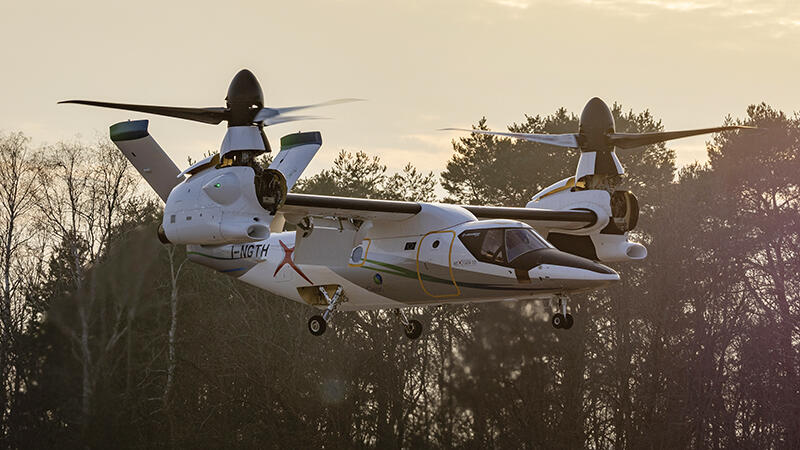
The NGCTR-TD’s new V-tail and much larger engine and gearbox nacelles were noticeable during the first flight on Dec. 19.
Credit: Leonardo Helicopters
Even though the AW609 has not yet reached the market, Leonardo is embarking on the next stage of its tiltrotor journey.
In December, the company achieved the long-awaited first flight of its Next-Generation Civil Tiltrotor Technology Demonstrator (NGCTR-TD), a platform intended to validate leaps in performance and efficiency and shape Europe’s future commercial and military rotorcraft.
- The NGCTR-TD will test a new approach to fly-by-wire controls
- The platform is the first demonstrator on the European civil register
The milestone took place at Leonardo’s facility at Cascina Costa near Milan on Dec. 19—11 years after NGCTR-TD development began, 17 months after initial ground tests started and 20 months after competitor Airbus completed the first flight of its Racer compound rotorcraft demonstrator.
Development of both the NGCTR-TD and Racer was funded by the European Union’s Clean Sky 2 research and development initiative.
Leonardo intends the aircraft to help derisk technologies for a larger commercial tiltrotor capable of carrying 25-30 people, which could pave the way to a new battlefield transport and naval rotorcraft. “Bringing this technology demonstrator to the air for the first time sets a major milestone on our path to provide a key contribution toward an even more advanced, effective and sustainable use of rotorcraft technologies in Europe,” Leonardo Helicopters Managing Director Gian Piero Cutillo said following the flight.
Several of the NGCTR-TD’s design traits appeared on Leonardo and Bell’s proposed 16-metric-ton tiltrotor in concept studies presented for NATO’s Next-Generation Rotorcraft Capability (AW&ST Nov. 24-Dec. 7, 2025, p. 26).
For the demonstrator, engineers equipped a donor AW609 commercial tiltrotor airframe with several new technologies to raise their technology readiness levels. Among them is a new main wing architecture that provides more volume for fuel and features a large morphing trailing edge flap to reduce download from the proprotors during hover. The rotorcraft also uses a straight wing rather than the AW609’s slightly forward swept wing.
Engineers adopted a fixed-engine, split-gearbox configuration like the one on Bell’s V-280 to drive the prop-rotors. A fixed-engine configuration reduces complexity and the need to certify an engine to operate at various tilt angles, as on the AW609 and the Bell-Boeing V-22 Osprey, and broadens the engine options that can be used on a tiltrotor. However, this makes for a considerably bulkier nacelle. A V-280-like V-tail also helps reduce drag and improve aerodynamic stability.
The NGCTR-TD will also test a new approach to fly-by-wire controls, moving from the federated architecture on the AW609 to a more modular and distributed system in which actuator control and verification is performed by electronic units close to the actuator rather than a central processing unit. This alleviates the need for heavy wiring, which reduces aircraft weight and complexity. The rotorcraft uses General Electric CT7 engines rather than the AW609’s Pratt & Whitney Canada PT6s, in part because of the CT7’s Full-Authority Digital Engine Control and frontal air intake. Leonardo is also familiar with the engine from programs such as the AW101 and AW189, as well as the NHIndustries NH90.
Unlike the AW609 and Airbus’ Racer, the NGCTR is developed for single-pilot operations and features an ejection seat.
The aircraft is also the first tiltrotor to be inducted on a European civil registration—I-NGTH. All AW609 development aircraft have U.S. N-numbers, reflecting the type’s heritage and continuing certification slog with the FAA.
Development of the NGCTR-TD has been a pan-European effort, involving around 70 industry partners, research and academic centers in 14 countries. Several consortia were established for key components of the aircraft. The main wing was produced by the T-Wing consortium, which included the Italian Aerospace Research Centre, Germany’s IBK Innovation and Italy’s Magnaghi Aeronautica and Officine Meccaniche Irpine. The thermoplastic V-tail’s development through the Light Innovative Flying Tiltrotor Tail consortium was led by GKN’s Fokker and the Netherlands Aerospace Center.
Some 200 hr. of flight testing are expected to follow. Although Leonardo has yet to outline test plans, company officials have talked about reaching speeds of 280 kt. Rotorcraft development used up EU funding, so flight testing will be performed on the company’s dime. The
NGCTR-TD has some catching up to do, however—Airbus has achieved many of its initial aims with the Racer, which is expected to move into the second phase of flight testing with its new electric eco-mode system that shuts down and spools up one of the two engines during cruise.