Sent: Wednesday, April 8, 2026 12:54 PM
To: Brattland, Mike * <mgbrattland@gerlecreek.com>
Subject: Aviation Weel :: The Week In Technology, March 30-April 3, 2026
Superman better watch out.....
Check out this site https://aviationweek.com/aerospace/aircraft-propulsion/week-technology-march-30-april-3-2026
--

The Sunbird nuclear fusion rocket exhaust has achieved the “first plasma” milestone using inert krypton as the fuel.
Credit: Pulsar Fusion
Pulsar Fusion Tests Nuclear Rocket Exhaust
UK space propulsion company Pulsar Fusion has conducted the first test of a prototype exhaust system for a nuclear fusion rocket engine that could dramatically cut transit times for missions to Mars and beyond.
Based in Bletchley, England, the company announced on March 25 it had achieved “first plasma” in its Sunbird exhaust test system, which has the physical architecture of a direct fusion drive (DFD) space propulsion system.
“With a space mission, you have a choice: chemical rockets or electric thrusters. We build both,” Pulsar Fusion CEO Richard Dinan says. “The problem is rockets give you really high thrust, but very little specific impulse, while ion engines give you tremendous speed, but it might take you 100 years to get that, as the thrust is infinitesimal.”
Specific impulse (Isp), the thrust produced per unit of propellant consumed, is a measure of rocket efficiency. In-space chemical rocket Isp is typically 300-450 sec. The Isp of Hall-effect ion thrusters is 1,000-3,000 sec.
“Fusion can give you a phenomenal specific impulse, about 13,000 sec., and has potential—if you can get your exhaust system to be efficient—to give you significant amounts of thrust,” Dinan says. “So rather than this constant trade-off between thrust or speed, this means you could dramatically cut your travel time around the Solar System.”
In a fusion power reactor, hydrogen isotopes are heated to extreme temperatures, releasing high-energy neutrons that strike the reactor walls and generate intense heat that is used to drive a steam turbine and generate electricity.
A DFD system produces thrust directly from fusion rather than indirectly by generating electricity to power ion thrusters, as in nuclear-electric propulsion. Aneutronic fusion fuel is used that releases energy in the form of protons—charged particles that can be confined, heated and directed by magnetic fields in the exhaust system to produce thrust.
In its plans to develop the DFD concept, Pulsar Fusion is focusing first on its exhaust system so it can provide performance data to spacecraft primes and mission planners, “because then we’ll be able to set ourselves a goal of where we need to be to create useful missions,” Dinan says.
“It is important to say there is no fusion happening in this at the moment. This is just a first step of holding a plasma in place so that we can use this as a building block to start upping the temperature,” he says. “This is just the first plasma in approximately the right place, showing that the magnets are actually holding the plasma in the engine. We will do a lot better, I hope, after this. We’ll be able to get much, much higher temperatures, and then, one day, we might make the decision to switch to fusion fuels.”
Next steps will include performance testing, upgrading the system with superconducting magnets to enable stronger magnetic fields, and exploration of higher plasma density and pressure. Pulsar Fusion is also working with the UK Atomic Energy Authority to maximize the mission lifetime of the Sunbird exhaust system.
“To use fusion as a propulsion source, it’s not just the physics of the kinetic energy from the reaction; it’s also how efficient your exhaust is,” Dinan says. “You might have kinetic energy from a fusion plasma, which you could punch into a computer to give you a space mission, but if your exhaust is only 50% efficient, it might change a five-year mission into a 500-year mission.”
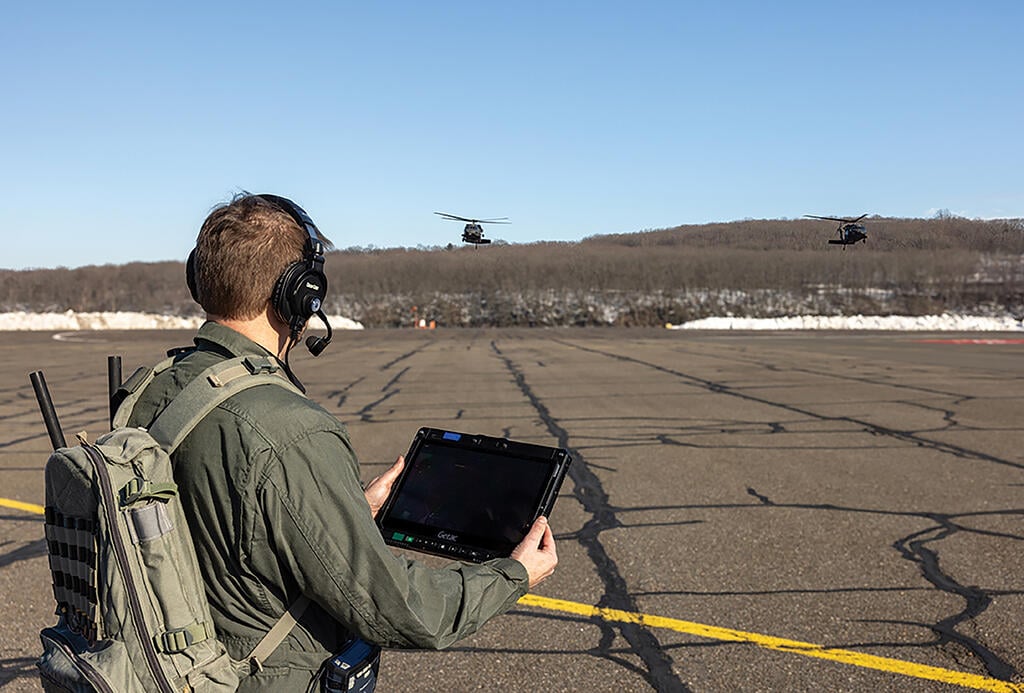 The Matrix autonomy mission manager enables the UH-60MX to be controlled from the ground using a tablet. Credit: Sikorsky
DARPA’s ALIAS Autonomy Transitions To The Army
One of DARPA’s longest-running projects is wrapping up as the autonomy technology developed under its ALIAS program transitions to the U.S. Army. Delivery of a Sikorsky UH-60M Black Hawk equipped with the company’s Matrix autonomy system to the Army marks the culmination of the 12-year project.
ALIAS, for Aircrew Labor In-cockpit Automation System, was launched in 2014 to develop a removable kit that could be installed in any aircraft to give it a high degree of automation to reduce workload, improve safety and allow pilots to focus on higher-level mission tasks.
Since then, Sikorsky’s Matrix autonomy management system has flown on more than 20 platforms and accumulated more than 1,000 flight hours. These include the company’s S-76 Sikorsky Autonomy Research Aircraft and S-70 Optionally Piloted Vehicle (OPV) demonstrator, a modified UH-60A.
Sikorsky is also installing Matrix on its S-70UAS U-Hawk uncrewed cargo conversion of the UH-60L Black Hawk, its Nomad family of rotor blown wing vertical-takeoff-and-landing (VTOL) uncrewed aircraft systems (UAS) and its planned HEX hybrid-electric tiltwing VTOL demonstrators.
Matrix has also been flight-tested in a Cessna Caravan and trialed on an ATR 42 freighter owned by FedEx. In early March, the system was selected by Robinson Helicopters as the autonomy stack for the TurbineTruck uncrewed cargo derivative of the R66 light helicopter.
A key to ALIAS and the deployment of Matrix has been Sikorsky’s development of a fly-by-wire system that can affordably convert existing mechanically controlled aircraft such as the Black Hawk to full-authority digital flight control to enable autonomous operation.
The UH-60MX autonomy testbed delivered to the Army on March 19 uses the same fly-by-wire system and Matrix autonomy mission manager as the OPV Black Hawk, but Sikorsky is testing lower-cost fly-by-wire and Matrix system hardware on the U-Hawk, which is planned to fly shortly.
Sikorsky has now installed Matrix in all three major models of the Black Hawk operated by the Army, the UH-60A, L and M. The UH-60MX will be used by Army Combat Capabilities Development Command as a flying laboratory to mature and expand autonomy technology.
The UH-60MX will be used to help develop tactics, techniques and procedures for the operation of optionally piloted and fully autonomous aircraft. The next phase will integrate mission-specific sensors and explore the operational flexibility afforded by reduced-crew and fully autonomous flight.
DARPA, Sikorsky and the Army are installing Matrix in a UH-60L under a program with Texas A&M University to demonstrate autonomous wildland firefighting. “DARPA is concluding the ALIAS program and will continue transition activities to Texas and the Army,” the Pentagon research agency says.
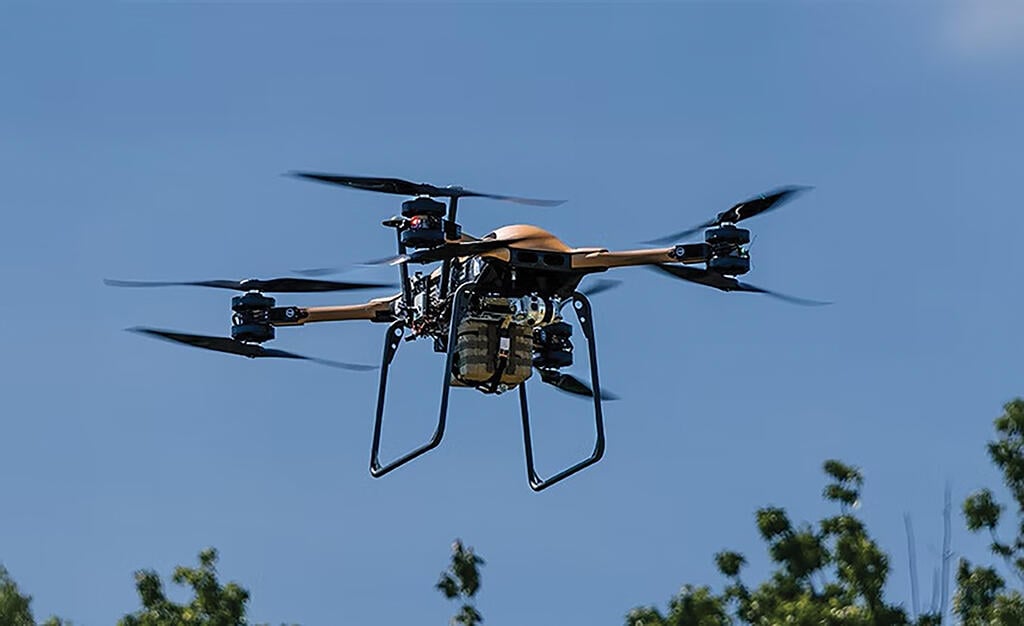 Near Earth’s Firefly compact autonomous flight system has flown on BAE Systems’ TRV-150 heavy-lift cargo drone. Credit: BAE Systems
Near Earth Advances Contested Maritime Logistics
Near Earth Autonomy is to develop further the U.S. Marine Corps’ ability to fly uncrewed logistics missions under a contract awarded through the Naval Aviation Systems Consortium. The Pittsburgh-based company is to develop an aircraft-agnostic autonomy system for ship-to-shore and shore-to-ship logistics missions in contested maritime environments.
The autonomy will be based on Near Earth’s Firefly compact flight system, a 2-lb. unit that includes lidar, infrared and high-definition camera sensors for obstacle avoidance, ship acquisition and landing.
Firefly is designed for use on Group 3 and 4 uncrewed aircraft and has flown on BAE Systems’ TRV-150 heavy-lift multicopter cargo drone as well as the L3Harris Technologies FVR-90 and PteroDynamics Transwing winged vertical-takeoff-and-landing uncrewed aircraft.
“All of the perception, data processing and autonomy algorithms are handled within the Firefly unit,” Near Earth says. “The system does not require a network connection to function. This is particularly relevant for military and rural environments where data access isn’t always available.”
The Marine Corps has previously ordered Firefly units for field trials of autonomous resupply in contested environments using the TRV-150C under a contract awarded by Survice Engineering, prime contractor for the Marines’ Tactical Resupply Unmanned Aircraft System program.
Under the latest contract, Near Earth will develop capabilities including autonomous confined area operations, recovery to the ship in emissions-controlled environments and GPS-denied navigation. “This contract with the Navy is a key next step, maturing our autonomous systems’ performance for maritime missions,” Near Earth CEO Sanjiv Singh said in a statement.
Near Earth’s autonomy systems have previously been used to demonstrate uncrewed logistics capabilities under the Office of Naval Research’s Autonomous Aerial Cargo/Utility Resupply and Marine Corps’ Unmanned Logistics Systems - Air and Aerial Logistics Connector demonstration programs.
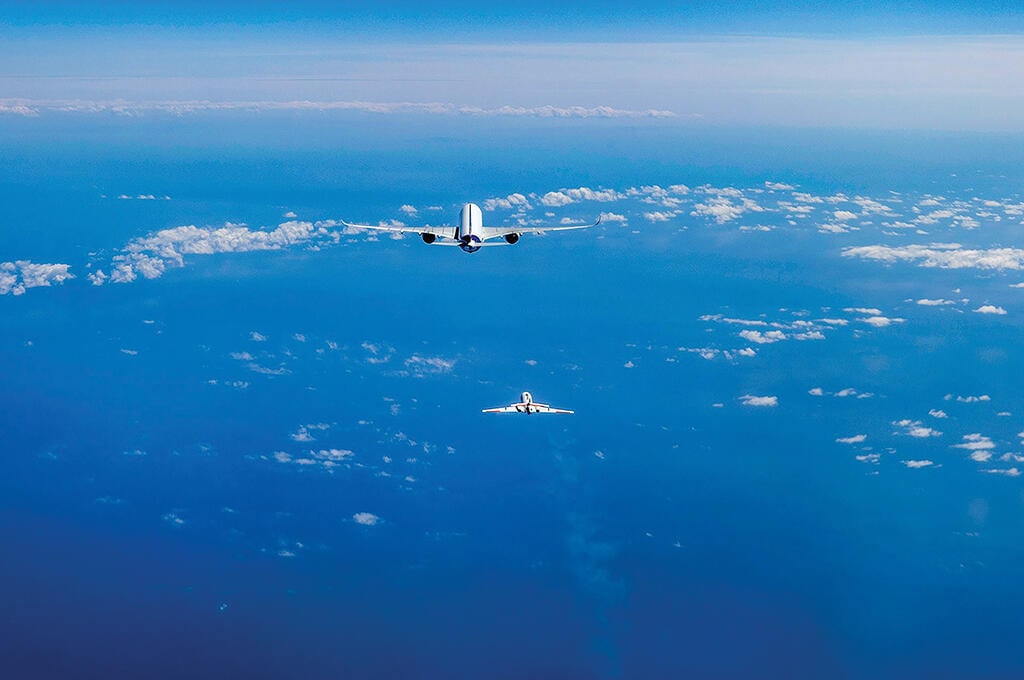 ECLIF-X is the latest in a series of test campaigns to measure aircraft emissions and contrails in flight. Credit: DLR
Airbus Explores Sulfur’s Role In Contrails
Airbus is leading a flight-test campaign to measure the effect of sulfur content in jet fuel on contrail formation and mitigation. The inflight emissions measurement campaign is using an Airbus A321XLR test aircraft powered by Pratt & Whitney PW1100G geared turbofans.
Contrails form when an aircraft flies through ice-supersaturated regions of the atmosphere and water condenses onto particles in the engine exhaust and forms ice crystals. Persistent contrails are the major contributor to aviation’s non-CO2 emissions.
The ECLIF-X research campaign is a continuation of the Emissions and Climate Impact of Alternative Fuels program to study how sustainable aviation fuels (SAF) reduce aircraft emissions and contrails. This included ECLIF1 in 2015 and ECLIF2 in 2018 with an IAE V2500-powered Airbus A320, and ECLIF3 in 2024 with a Rolls-Royce Trent XWB-powered Airbus A350.
The X in ECLIF-X refers to the Talon-X rich-burn combustor in Pratt’s PW1100G, which is designed to reduce soot emissions. Soot and volatile particles in the engine exhaust plume act as seeds for the formation of the ice crystals in contrails.
Aromatic hydrocarbons in jet fuel are the primary precursors for soot particles. Sulfur in the fuel forms sulfuric acid, which can either form a coating on soot particles that attracts water vapor or lead to the formation of volatile particles that also attract water vapor. The two types of particle can compete and interact during the contrail formation process, Airbus says.
ECLIF-X aims to assess the effect of low-sulfur/low-aromatics fuel on the PW1100G’s emissions and contrail properties. The flight-test campaign involves inflight measurements with German aerospace center DLR’s Dassault Falcon 20E research aircraft flying 50-300 m (165-980 ft.) behind the A321XLR.
The campaign, which runs to 2027, is testing three different fuels with a range of sulfur content: conventional Jet A-1 with approximately 200 parts per million (ppm) sulfur; a special batch of high-sulfur (650 ppm) Jet A-1; and very-low-sulfur (less than 1 ppm), low-aromatic hydrotreated Jet A-1.
Airbus says the ECLIF-X tests are expected to quantify the reduction in soot and ice crystal formation achievable by reducing the aromatic and sulfur content of jet fuel.